
Month: July 2026

The Sharp End Skills, stories & signals shaping tomorrow’s teams Edition 10 — July 2026
The Sharp End Skills, stories & signals shaping tomorrow’s teams Edition 10 — July 2026
July 28, 2026
Market Signal
85% of researchers say automated tools have already improved their workflow — primarily by saving time and enabling faster delivery. Automation now supports every stage of the research process, from brief sharpening to survey design, fieldwork, and synthesis. The execution layer is largely solved.
What remains unsolved — and increasingly urgent — is interpretation.
McKinsey’s 2026 Skill Change Index makes the argument directly: AI will not render human judgment obsolete. It will reshape how it is applied. The highest-value work in 2026 is no longer generating data. It is framing the right questions, interpreting ambiguous findings, communicating insight to stakeholders, and validating AI outputs against organisational reality.
Meanwhile, the industry is naming the shift itself. Brands are now expecting research partners who can operate in the blended space of strategy and insight — comfortable with data, fluent in commercial context, able to translate findings into decisions. Insight teams are building capabilities in narrative framing, behavioural interpretation, and strategic translation. The research project manager and the strategic consultant are no longer interchangeable roles. The premium is moving decisively toward the second.
Frontline
A head of insight at a consumer brand, reflecting on how her team’s remit has changed in the past eighteen months:
“We used to spend most of our time on the mechanics — designing studies, managing suppliers, quality-checking outputs. Now the platforms do most of that. What I need from my team is something harder. I need them to sit in a room with the commercial director and tell him what the data actually means for his decision. Not present it. Interpret it. That’s a completely different skill — and not everyone has made the transition.”
This is the gap the edition is about. Not between those who use AI and those who don’t. Between those who can tell you what the data shows and those who can tell you what to do about it.
Sharp Skill: Interpretive Courage
Interpretation is not just an analytical capability. It is a professional posture — and it requires something that no tool can supply: the willingness to take a position.
The research and strategy profession has long rewarded neutrality. Present the findings. Let the data speak. Offer options rather than recommendations. This posture made sense when the risk of being wrong was career-limiting and the value of the researcher lay in their methodological rigour. It makes less sense when AI can produce methodologically rigorous outputs at scale and what organisations actually need is someone willing to say what those outputs mean.
There is a documented pressure working against this. When AI produces a confident, well-structured output, the professional who disagrees with it faces a specific career risk: being seen to override the algorithm is uncomfortable, and deferring to it feels safer. The result is that interpretation — genuine, situated, commercially-aware interpretation — gets quietly replaced by AI-endorsed summary. The findings look sharp. The thinking behind them has been outsourced.
Three moves that build interpretive capability:
1. Separate what the data shows from what it means. Make it a discipline, not an assumption. “The data shows X” and “this means Y for your situation” are two distinct statements. Train yourself to make them explicitly, in that order, every time. The second statement is yours. Own it.
2. Know the commercial context before you know the findings. Interpretation that lands is always situated. What pressure is the commercial director under? What decision is actually on the table? What would change the outcome? The strategist who walks into the debrief knowing the answers to those questions interprets differently — and more usefully — than one who arrives with only the data.
3. Make a recommendation, not a menu. “Here are three possible interpretations” is a research deliverable. “Here is what I think this means, and here is what I would do” is a consulting one. The second is harder, more exposed, and significantly more valuable. If you are consistently offering options rather than recommendations, ask yourself honestly whether that is intellectual rigour or professional self-protection.
Case in Point
The split your audience is living through is not theoretical. It is showing up in how roles are being structured and what is commanding a premium in the market right now.
The research project management layer — scoping, commissioning, supplier management, delivery — is being absorbed into platforms and automated workflows. The organisations investing in headcount are doing so for a different capability: the ability to sit with a client before the brief is written, understand the commercial context, interpret findings in light of organisational reality, and take a clear position on what should happen next.
This is not a new distinction. The difference between a research project manager and a strategic consultant has always existed. What is new is the speed at which the first role is being automated and the premium being placed on the second. The strategists and researchers who thrive in this environment will not be those who executed the most studies. They will be those who learned to interpret — and had the courage to say so out loud.
Closing Thought
AI tells you what happened. Interpretation tells you what to do about it.
For most of the profession’s history, the first part was the hard part — gathering the data, running the study, producing the output. The second part was assumed to follow naturally from sufficient rigour and experience.
That assumption no longer holds. Execution is fast, cheap, and increasingly automated. Interpretation is scarce, situated, and irreducibly human. The gap between those two things is where the next generation of strategic value will be built.
The question is not whether you can produce the findings. It is whether you are willing to stand behind what they mean.
That is the sharper edge.
The Sharp End is a monthly field guide for strategists, researchers, and insight leaders. If this edition resonated, share it with someone who is ready to move from presenting findings to owning what they mean.
Not yet subscribed?
The Sharp End Skills, stories & signals shaping tomorrow’s teams Edition 11 — August 2026
The Sharp End Skills, stories & signals shaping tomorrow’s teams Edition 11 — August 2026
July 28, 2026
Market Signal
85% of researchers say automated tools have already improved their workflow — primarily by saving time and enabling faster delivery. Automation now supports every stage of the research process, from brief sharpening to survey design, fieldwork, and synthesis. The execution layer is largely solved.
What remains unsolved — and increasingly urgent — is interpretation.
McKinsey’s 2026 Skill Change Index makes the argument directly: AI will not render human judgment obsolete. It will reshape how it is applied. The highest-value work in 2026 is no longer generating data. It is framing the right questions, interpreting ambiguous findings, communicating insight to stakeholders, and validating AI outputs against organisational reality.
Meanwhile, the industry is naming the shift itself. Brands are now expecting research partners who can operate in the blended space of strategy and insight — comfortable with data, fluent in commercial context, able to translate findings into decisions. Insight teams are building capabilities in narrative framing, behavioural interpretation, and strategic translation. The research project manager and the strategic consultant are no longer interchangeable roles. The premium is moving decisively toward the second.
Frontline
A head of insight at a consumer brand, reflecting on how her team’s remit has changed in the past eighteen months:
“We used to spend most of our time on the mechanics — designing studies, managing suppliers, quality-checking outputs. Now the platforms do most of that. What I need from my team is something harder. I need them to sit in a room with the commercial director and tell him what the data actually means for his decision. Not present it. Interpret it. That’s a completely different skill — and not everyone has made the transition.”
This is the gap the edition is about. Not between those who use AI and those who don’t. Between those who can tell you what the data shows and those who can tell you what to do about it.
Sharp Skill: Interpretive Courage
Interpretation is not just an analytical capability. It is a professional posture — and it requires something that no tool can supply: the willingness to take a position.
The research and strategy profession has long rewarded neutrality. Present the findings. Let the data speak. Offer options rather than recommendations. This posture made sense when the risk of being wrong was career-limiting and the value of the researcher lay in their methodological rigour. It makes less sense when AI can produce methodologically rigorous outputs at scale and what organisations actually need is someone willing to say what those outputs mean.
There is a documented pressure working against this. When AI produces a confident, well-structured output, the professional who disagrees with it faces a specific career risk: being seen to override the algorithm is uncomfortable, and deferring to it feels safer. The result is that interpretation — genuine, situated, commercially-aware interpretation — gets quietly replaced by AI-endorsed summary. The findings look sharp. The thinking behind them has been outsourced.
Three moves that build interpretive capability:
1. Separate what the data shows from what it means. Make it a discipline, not an assumption. “The data shows X” and “this means Y for your situation” are two distinct statements. Train yourself to make them explicitly, in that order, every time. The second statement is yours. Own it.
2. Know the commercial context before you know the findings. Interpretation that lands is always situated. What pressure is the commercial director under? What decision is actually on the table? What would change the outcome? The strategist who walks into the debrief knowing the answers to those questions interprets differently — and more usefully — than one who arrives with only the data.
3. Make a recommendation, not a menu. “Here are three possible interpretations” is a research deliverable. “Here is what I think this means, and here is what I would do” is a consulting one. The second is harder, more exposed, and significantly more valuable. If you are consistently offering options rather than recommendations, ask yourself honestly whether that is intellectual rigour or professional self-protection.
Case in Point
The split your audience is living through is not theoretical. It is showing up in how roles are being structured and what is commanding a premium in the market right now.
The research project management layer — scoping, commissioning, supplier management, delivery — is being absorbed into platforms and automated workflows. The organisations investing in headcount are doing so for a different capability: the ability to sit with a client before the brief is written, understand the commercial context, interpret findings in light of organisational reality, and take a clear position on what should happen next.
This is not a new distinction. The difference between a research project manager and a strategic consultant has always existed. What is new is the speed at which the first role is being automated and the premium being placed on the second. The strategists and researchers who thrive in this environment will not be those who executed the most studies. They will be those who learned to interpret — and had the courage to say so out loud.
Closing Thought
AI tells you what happened. Interpretation tells you what to do about it.
For most of the profession’s history, the first part was the hard part — gathering the data, running the study, producing the output. The second part was assumed to follow naturally from sufficient rigour and experience.
That assumption no longer holds. Execution is fast, cheap, and increasingly automated. Interpretation is scarce, situated, and irreducibly human. The gap between those two things is where the next generation of strategic value will be built.
The question is not whether you can produce the findings. It is whether you are willing to stand behind what they mean.
That is the sharper edge.
The Sharp End is a monthly field guide for strategists, researchers, and insight leaders. If this edition resonated, share it with someone who is ready to move from presenting findings to owning what they mean.
Not yet subscribed?
The Strategy Pulse | July 2026: The Proximity Play
The Strategy Pulse | July 2026: The Proximity Play
July 10, 2026
Six months ago, most leaders were still calling hybrid work the settled question. It isn’t.
WPP now expects four office days a week including two Fridays a month. Barclays has moved 85,000 staff from two office days to three. John Lewis & Partners has mandated three days for buying and merchandising teams. JD Sports Fashion UK head office staff have been back four days since last year.
None of this is being sold as a productivity fix. It’s being sold as culture, coaching, and collaboration. Worth asking why the sudden urgency, several years after the pandemic supposedly settled this.
Big Shift: The office is back as a control mechanism
For a while, remote and hybrid work were treated as a talent retention tool. Now they’re being treated as a risk to manage. The shift in language is the tell. Barclays talks about “balancing flexibility… with the importance of working together.” WPP‘s memo leaned on collaboration and creative culture.
What’s actually changed is confidence. When hiring was tight and attrition was expensive, flexibility was a lever companies pulled to keep people. Now, with several sectors seeing looser labour markets, that lever matters less. The return to work (RTO) wave isn’t a discovery that offices work better. It’s a signal that the balance of power has shifted back toward the employer, and offices are the most visible way to demonstrate that.
For hiring and org design, this matters more than the policy itself. A company’s stance on where work happens is now a genuine differentiator in the market for talent, not a footnote in the offer letter. Candidates are reading these announcements as signals about trust, not just logistics.
📌 Takeaway: Watch what a return-to-office mandate says about confidence in the labour market, not just about where people sit.
Brand in Focus: WPP
WPP announced its four-day office policy back in January, effective from April. Staff pushed back hard: a petition calling for the CEO to reverse the mandate picked up more than 18,000 signatures. Employees in London reported the offices simply weren’t built for the volume. Not enough screens to connect laptops. Missing cables. No spare desks. Patchy wifi. Morale, by most accounts, dropped rather than lifted.
The irony is hard to miss for a company that sells culture and creative collaboration as its product. WPP is one of the world’s largest marketing services groups, built on the pitch that bringing people together produces better creative work. When the internal reality of “coming together” turns out to be a scramble for a free desk, the policy undercuts the exact brand story it’s meant to reinforce.
📌 Takeaway: If your product is culture and collaboration, your own office experience becomes part of the pitch, whether you plan for that or not.
Consulting Corner: The mid-market squeeze
Away from the office wars, consulting itself is being reshaped by the same underlying force: AI capability changing who needs how many people. AI-native boutiques can now run research, modelling, and analysis that used to require a bench of junior analysts, letting small teams take on scopes that once needed a much bigger team. At the other end, the largest firms are scaling through acquisition and platform investment to keep pace.
Caught in the middle are mid-sized firms with neither the balance sheet to compete for enterprise transformation work nor the lean cost base to match boutique pricing. Several analysts now expect that segment to shrink meaningfully over the next few years, leaving an industry split between global scale players and specialist boutiques.
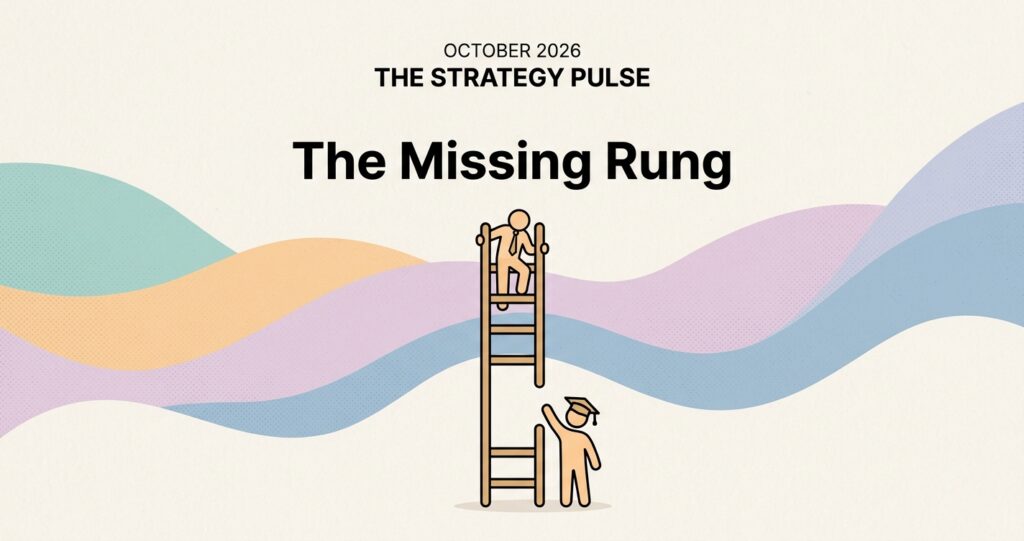
The talent consequence is worth noting. If junior analyst work is increasingly automated and mid-market firms (traditionally a training ground for that talent) are shrinking, the traditional consulting career ladder starts to look shorter and steeper at the bottom. Firms that figure out a new apprenticeship model, rather than just cutting junior headcount, will have a real hiring advantage in a few years.
📌 Takeaway: The consulting talent pipeline is being squeezed from both ends. Firms that solve for junior development now will be the ones with a bench later.
🔔 Final Thought
Two structural stories running in parallel this year: where work happens, and who gets to do the work at all as it gets automated. Both come back to the same question for leaders. Mandates are free. Career development isn’t. Most companies picked the free option this year.
Want to stay on top of this? The Strategy Pulse continues monthly.
In the meantime, if you found this useful, share it with someone navigating their own proximity play.